

Web designer vs. web developer: what you are actually hiring
The terms get used interchangeably, but they describe different jobs. A web designer decides how a site looks and works for visitors: layout, typography, navigation, and the path from landing on a page to calling you. A web developer turns that design into working software: the front end people interact with, the back end that stores data, and the integrations with your CRM, booking system, or payment processor.
Many Houston businesses search for "a web developer" when they really need both, plus someone to make sure Google can find the result. Knowing which skills your project needs is the first step to hiring well. If the look and usability of your site is the main problem, start with UX/UI design; if it needs portals, integrations, or custom features, you need serious web development.
Three ways to hire, compared
There is no universally right answer. Each model trades cost against risk, speed, and depth in a different way:
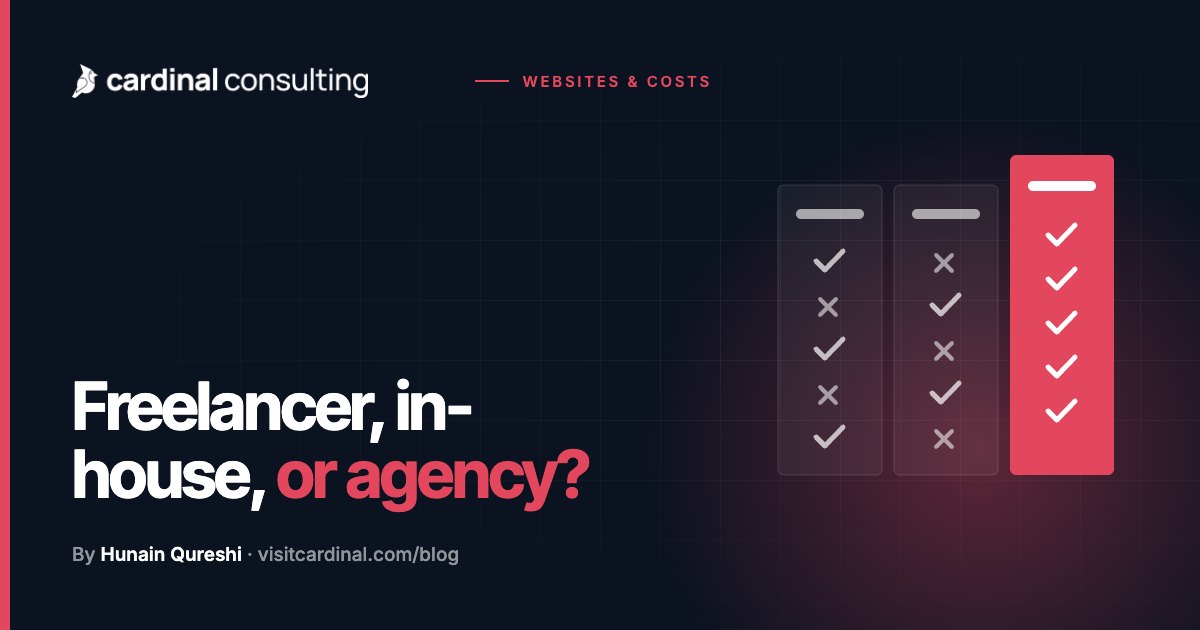
Freelancer vs. in-house vs. agency
Swipe sideways to see every column.
| Factor | Freelancer | In-house hire | Agency |
|---|---|---|---|
| Upfront cost | Lowest | Highest | Middle |
| Design, development, and SEO in one place | |||
| Coverage when someone is out | |||
| Time to start | Days | Months | Weeks |
| Deep knowledge of your business | |||
| Best for | Small, defined jobs | Software as your product | Revenue-critical sites |
When a freelance web developer is the right call
A good freelancer can be excellent value. If you need a landing page, a set of fixes on an existing site, or a small build with a clear specification, one skilled person is often faster and cheaper than a team.
The risk is concentration. One person is responsible for design, code, hosting, security, and support, and if they get busy, change careers, or disappear, your website is stuck. Before hiring a freelancer, ask who covers for them, and make sure every account is in your name from day one.
When to hire an in-house developer
If software is your product, or you have a steady stream of development work for years to come, a full-time developer can make sense. They build deep knowledge of your systems and are available every day.
Count the full cost, though: salary, benefits, recruiting, equipment, software licenses, management time, and the gap when they take leave or move on. One developer also rarely covers design, security, DevOps, and SEO equally well, so many companies still bring in specialists for those areas.
When a Houston web development agency makes sense
An agency costs more than a freelancer but gives you a team: designers, developers, and SEO specialists who have shipped many similar projects, with someone accountable for the whole result. That matters most when the website carries revenue, connects to other systems, or needs ongoing care.
Agencies vary widely, so judge them on live work and process rather than size. A strong agency will also tell you when a smaller option fits better. At Cardinal, the same team handles web development, AI features and automation, and maintenance after launch, so nothing falls between vendors.
The web developer skills checklist for 2027
Whoever you hire, these are the skills a modern business website depends on. Ask candidates to show where they have applied each one:
- A modern, well-supported framework and a clear reason for choosing it
- Performance work that meets Google's Core Web Vitals thresholds
- Accessibility in line with WCAG 2.2
- Security practices covering the OWASP Top 10 risks, such as injection and broken access control
- Technical SEO: crawlable pages, structured data, sitemaps, and redirects
- Integrations with CRMs, payment processors, booking tools, and APIs
- Analytics and conversion tracking
- A content management setup your team can use without a developer
- Version control, automated deployments, and backups
How to vet a web developer in one week
You can learn more in five structured steps than in months of back-and-forth. This is the process I would follow:
A one-week vetting process
- 1
Write a one-page brief
Your goal, the pages and features you need, the tools it must connect to, your budget range, and two sites you like.
- 2
Test their live work
Run three recent client sites through PageSpeed Insights and use them on your phone. Screenshots can hide a slow, clumsy site; live sites cannot.
- 3
Call a past client
Ask what went wrong and how it was handled. Every project has problems; you are learning how they respond to them.
- 4
Start small
A paid discovery phase or a small first task shows how they communicate and estimate before you commit to the full build.
- 5
Get it in writing
Scope, timeline, payment milestones, ownership, and what happens after launch, all in one signed document.
Questions that reveal real expertise
Good developers answer these quickly and specifically. Hesitation or jargon-heavy non-answers are worth noting.
- How will you make the site fast on a mid-range phone over a cellular connection?
- How do you protect forms and logins from spam and attacks?
- What happens to our search rankings when you replace our current site?
- How will our team update content after launch?
- Where will the code live, and how do we get access to it?
- If you were unavailable for a month, how would our site be supported?
Protect yourself: ownership, access, and handoff
The most common disaster we see is not bad code; it is a business locked out of its own website. A developer registered the domain in their name, hosts the site on their personal account, or holds the only admin login, and when the relationship ends, so does access.
Avoid it with one rule: every account is created in your company's name, and the developer is added as a user. That includes the domain registrar, hosting, code repository, analytics, Google Search Console, and Google Business Profile. Ask for written documentation at handoff explaining how the site is built and deployed.
If you only remember one thing: the domain registrar account should be in your company's name, with your email address on it.
Frequently asked questions
Freelancers typically bill by the hour or project, full-time developers cost a salary plus benefits, recruiting, and tools, and agencies quote by project. For reference, Cardinal Consulting's websites start at $3,500 and custom platforms at $15,000, with a fixed price in writing.
Not sure which option fits your project? Tell us what you're building and we'll give you an honest recommendation, even if it isn't us.

Written by
Hunain Qureshi grew up online. He was a professional Counter-Strike player at 13, built PCs and hosted game servers as a teenager, and taught himself design before founding Cardinal Consulting in Houston in 2020. Read his story